
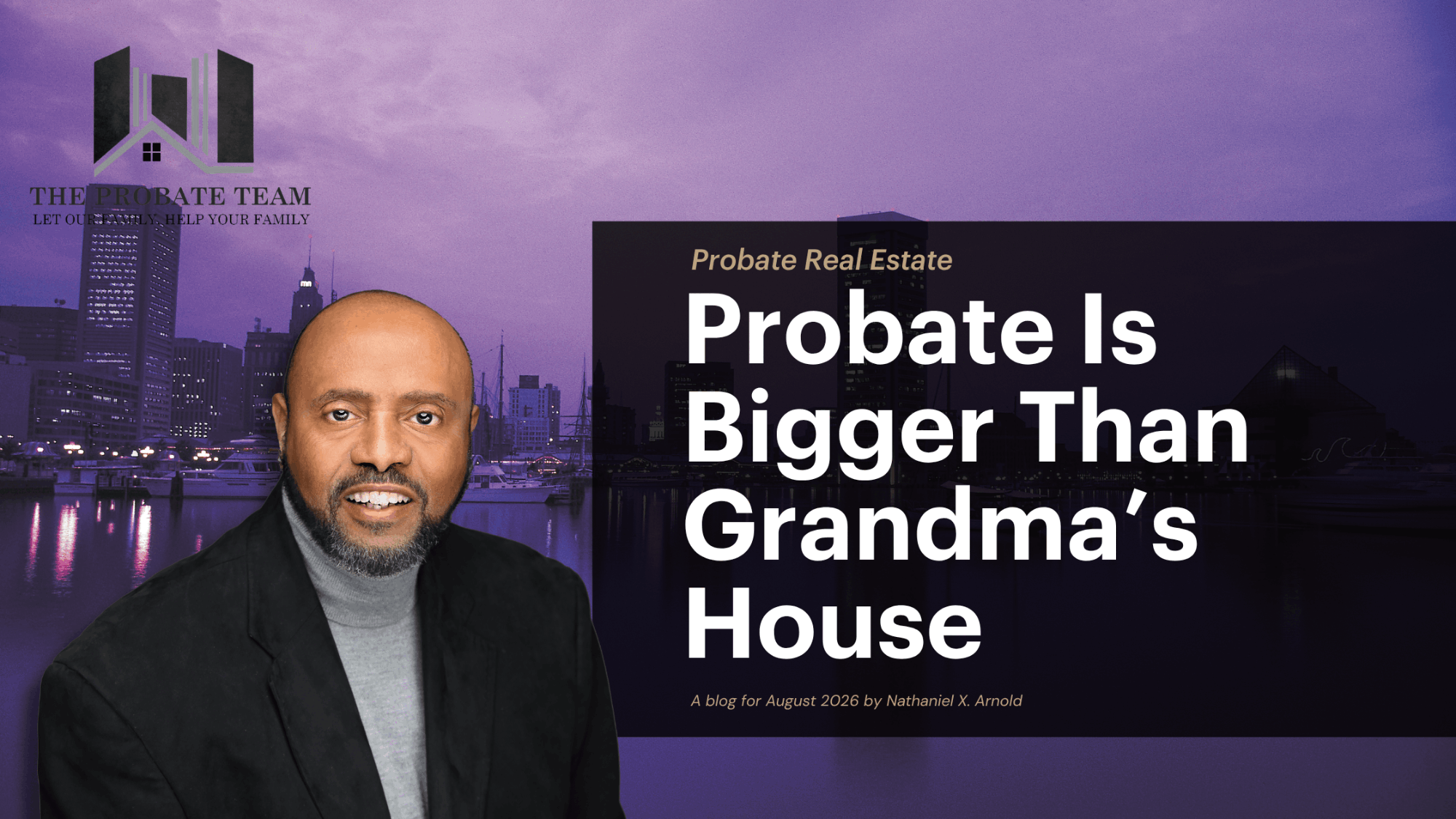
Probate Is Bigger Than Grandma’s House
When most people hear the words probate real estate, they form an immediate picture in their minds.
They imagine Grandma’s house.
It is the house where the family gathered for Thanksgiving. The furniture is old, the basement is filled with boxes, and the kitchen has not been renovated since Ronald Reagan was president. Grandma has passed away, her children have inherited the property, and now someone must decide what to do with it.
That certainly can be probate.
But probate is much bigger than Grandma’s house.
Probate may involve a rental property occupied by tenants who have not paid rent in months. It may involve vacant land that the family did not know the deceased owned. It may involve a commercial building, a vacation home, several investment properties, or a house facing foreclosure. It may involve a property with a reverse mortgage, a title problem, years of deferred maintenance, or heirs scattered across the country.
Sometimes the estate contains a home with substantial equity. At other times, the mortgage, taxes, liens, and repair costs appear to exceed the property’s value.
Every situation is different.
That is why probate real estate should never be treated as merely another listing. Probate is a process, an event, and often a problem that must be resolved before a property can
successfully reach the closing table.
Probate Begins With a Life, Not a Property
After working in probate real estate for nearly two decades, I have learned that every probate file tells a story.
Someone lived.
Someone accumulated possessions, opened accounts, signed documents, acquired property, developed relationships, and made decisions. Then that person died, leaving someone else responsible for bringing order to everything left behind.
That responsibility usually falls upon a personal representative. Depending upon the state and the circumstances, that person may also be called an executor or administrator.
The title sounds official. The assignment can feel overwhelming.
Most personal representatives have never administered an estate. They may be grieving while attempting to locate documents, communicate with relatives, secure property, pay expenses, speak with attorneys, understand court requirements, and determine what should be sold.
Meanwhile, the bills do not stop.
Mortgage payments may still be due. Property taxes continue to accumulate. Insurance must be maintained. Utilities, condominium fees, repairs, lawn care, and security may become the estate’s responsibility. If the property is vacant, a small maintenance issue can become a major problem before anyone notices it.
The personal representative may have legal authority, but that does not mean he or she automatically has the knowledge, time, or resources needed to manage real estate.
That is where experience matters.
An Estate Can Own Almost Any Type of Real Estate
One of the greatest myths surrounding probate is that it only involves older homeowners and outdated single-family houses.
An estate can own nearly any type of real property, including:
A primary residence
A condominium or cooperative unit
A rental property
A multifamily building
Vacant land
A farm
A vacation or seasonal home
A commercial property
A partially renovated property
A property owned with another person
Multiple properties in different states
The deceased may have been a homeowner, landlord, developer, business owner, or investor. Some families discover property they knew existed but never discussed. Others discover assets through tax records, mail, financial statements, deeds, or conversations with people who knew
the deceased.
Even when the family knows about a property, they may not understand its true condition or value.
A house that looks like a burden may contain significant equity. A property believed to be valuable may require extensive repairs or carry debt that changes the financial picture. Vacant land may appear insignificant until its zoning and development potential are examined. A small rental property may produce income—or hide years of unresolved tenant, maintenance, and licensing problems.
Probate requires us to look beyond appearances.
The real question is not simply, “What is the house worth?”
The better questions are: What does the estate own? What obligations are attached to it?
What problems must be resolved? What options are available? And which solution best serves the estate?
Not Every Probate Property Should Be Handled the Same Way
Traditional real estate is often presented as a straightforward process: prepare the property, place it on the market, accept an offer, and proceed to closing.
Probate is rarely that simple.
Before a property is sold, someone may need to determine who has authority to sign the listing agreement and contract. The estate may need to be opened. A personal representative may
need to be appointed. The will may need to be located and admitted. Interested parties may need to receive notice. Creditors may have claims. The title may contain old liens, ownership issues, or judgments.
Then there is the property itself.
Does it need repairs? Can the estate afford them? Is the house occupied? Are the occupants cooperating? Is personal property still inside? Is there sufficient insurance? Has the property
been secured? Are there code violations? Is foreclosure approaching? Do the heirs agree about the sale?
A family may want the highest possible price, but the estate may not have six months and $75,000 to renovate the property. Another estate may have sufficient time and money to make strategic improvements that substantially increase the sales price.
Neither approach is automatically right or wrong.
The correct strategy depends upon the estate’s circumstances.
A probate property might be sold through a traditional retail listing. It might be sold in its present condition to an investor. It might require renovation before it is marketed. It may become part of a joint venture or another carefully structured solution. In some situations, the family may decide not to sell at all.
The role of a knowledgeable probate real estate professional is not to force every family into the same box. It is to help the personal representative understand the property, the market, the risks, and the available paths forward.
Probate Is the Top of the Real Estate Funnel
Years ago, I thought probate was simply another real estate niche.
I was wrong.
A niche is a small, specialized corner of a larger industry. Probate is something more. Probate is an acquisition opportunity that can open the door to nearly every major real estate strategy.
One estate can lead to a traditional listing. Another may create an investment opportunity. A third may involve a wholesale transaction, renovation project, rental property, commercial
asset, land sale, referral, partnership, or distressed-property resolution.
Probate is not the end of the funnel. It is the top.
The death of a property owner creates a moment of transition. Control must pass from the deceased to someone who can lawfully manage the estate. Decisions must be made about property that may no longer fit the family’s needs, finances, location, or long-term plans.
The opportunity is real, but so is the responsibility.
Those who enter probate only searching for cheap houses misunderstand the business. Behind every potential transaction is a family, a fiduciary duty, and often a person trying to make difficult decisions during one of the most emotionally complicated periods of life.
The best probate professionals know how to recognize opportunity without forgetting humanity.
Families Need More Than a Real Estate Agent
Many capable real estate agents can market a house. They can place it in the multiple listing service, schedule showings, negotiate an offer, and coordinate a closing.
But probate families frequently need more than marketing.
They may need help identifying what must happen before the property can be sold. They may need reliable contractors, clean-out services, estate-sale professionals, locksmiths, title
professionals, lenders, attorneys, property managers, or investors. They may need someone who understands how all these pieces fit together.
This does not mean a real estate professional should practice law or give legal advice. Probate attorneys and the court have essential roles. It means the real estate professional should
understand the probate environment well enough to recognize problems, ask the right questions, coordinate with the appropriate professionals, and avoid making promises that cannot be kept.
That is the philosophy behind The Probate Investors Team™.
We are building more than a group of agents who sell inherited houses. We are creating an ecosystem that connects brokerage, investment, education, and estate solutions.
Our goal is to help families move from confusion to clarity and from property problems to practical resolutions.
Sometimes that resolution is a full-market listing.
Sometimes it is a quick, as-is sale.
Sometimes it requires time, repairs, negotiation, or creative thinking.
What matters is that the personal representative understands the options and can make an informed decision.
The House Is Only One Part of the Estate
Even when Grandma’s house is the central asset, the situation is still bigger than the house itself.
The property may represent family history, childhood memories, sacrifice, conflict, and unfinished conversations. One heir may see a financial asset. Another sees the last remaining connection to a parent. One family member may want to sell immediately, while another believes the property should remain in the family forever.
These are not merely financial disagreements. They are often emotional expressions of grief.
A house can be appraised. Grief cannot.
That is why probate real estate demands patience, sensitivity, and communication. The professional must be able to explain market realities without dismissing the family’s memories.
We must separate the emotional value of the home from its market value while respecting both.
Grandma’s house may need to be sold, but Grandma’s life should never be reduced to a transaction.
A Larger Vision of Probate Real Estate
Probate is one of the most overlooked opportunity streams in real estate because many agents and investors do not understand it. Some are intimidated by the legal language. Others assume probate takes too long, involves too many family disputes, or consists only of rundown houses.
Those assumptions cause them to miss the larger picture.
Every day, people die owning real estate. Every day, personal representatives are appointed.
Every day, families must decide whether to keep, rent, repair, refinance, or sell inherited property.
The need does not disappear when the market changes.
Interest rates may rise. Buyer demand may slow. Inventory may tighten. Technology may transform the way real estate is marketed. Yet death, inheritance, and the transfer of property continue.
That is why probate is not merely a temporary marketing campaign. It is a durable real estate business built around an unavoidable human transition.
But success in this field requires more than locating a courthouse record and mailing a letter.
It requires knowledge.
It requires relationships.
It requires systems.
Most important, it requires the right attitude. Families are not leads to be hunted. Personal Representatives are people to be helped. Property problems are not obstacles to exploit; they are challenges to resolve.
When we approach probate with that understanding, we begin to see what others miss.
Probate may begin with a death certificate and a court filing, but it can lead to listings, investments, partnerships, referrals, renovations, and long-term relationships. It can also give a struggling family the guidance necessary to complete a difficult responsibility and move forward.
So yes, probate may include Grandma’s house.
But it may also include her rental property, the vacant lot she inherited, the building she owned with her brother, the beach house no one discussed, or the property facing foreclosure because no one knew what to do.
Probate is bigger than Grandma’s house.
It is an entire world of property, people, problems, and possibilities.
And for those prepared to understand that world, serve families with integrity, and build the right team around every estate, probate is not simply another part of real estate.
It is real estate.
We're Here to Help
If you have questions about selling inherited property, current market conditions, or the probate process, we invite you to speak with one of our experienced Probate Specialists.
Call 301-485-5072 or visit our website to schedule a complimentary consultation.
"Helping Families Through Probate—One Estate at a Time."
Categories
Recent Posts
GET MORE INFORMATION